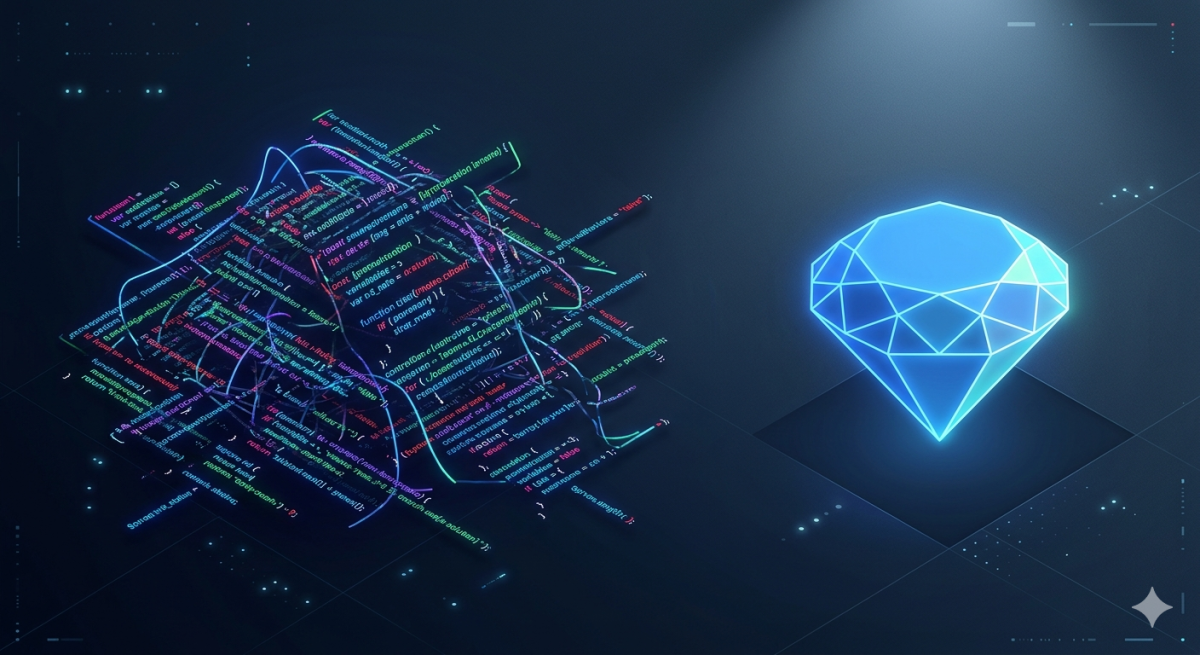
Maintenance Cost and the Expense Mindset
Writing the code takes up only a small slice of a project’s total lifetime. The real cost turns up later, while that code is kept alive for years, updated, and made to keep pace with a shifting environment (library upgrades, API changes and so on). From a Vibe Coder’s perspective, every new line you produce is a “maintenance tax” that falls due somewhere in the future.
The Vibe Coder’s Core Aim
A Vibe Coder’s real craft is measured not by how much code they write, but by how much code they manage to avoid writing. The goal is to orchestrate the solution with the least possible code, or with no-code/low-code tools, instead of drowning in syntax details. That shift takes a developer out of the “code laborer” role and turns them into a Product Engineer who makes strategic decisions.
Architecture and the Art of “Avoidance”
Avoiding code does not mean avoiding work. It means whispering the right architecture to the AI (Chapter 1.2), clearing out the code clutter and staying on the core of the system. If a problem can be solved with an existing API or an automation tool (Chapter 7.2) instead of 500 lines of custom code, the Vibe Coder takes the second road every time. Because code that was never written has no bugs, needs no maintenance and creates no technical debt.
This change of mindset is what keeps a project’s “vibe” intact. Staying on top of the system as a whole, instead of buried inside the code, makes you faster and more flexible. As we will get into in Chapter 5.1, forgetting the syntax is allowed; forgetting the architecture is how a project meets its end.
“Every line you don’t write is a shop you won’t have to sweep out tomorrow. Keep the shop airy so good fortune can find its way in.”
A very dear older brother of mine.